Pool Rummy Guide: Rules, Hand Building and Risk Limits
In pool rummy, players generally try to arrange a hand into valid sets and sequences while reducing the penalty value of unmatched cards. Scores may accumulate across deals, and a player may be eliminated at a stated limit, although card counts, declaration conditions and score limits vary by table. Third-party category descriptions mention rummy in connection with 3666bet, but they do not confirm that this specific pool-rummy format is currently available; check the live game list and rule panel before using money.

- Check the current game list
- Verify rules and score limits
- Practise with sample hands first
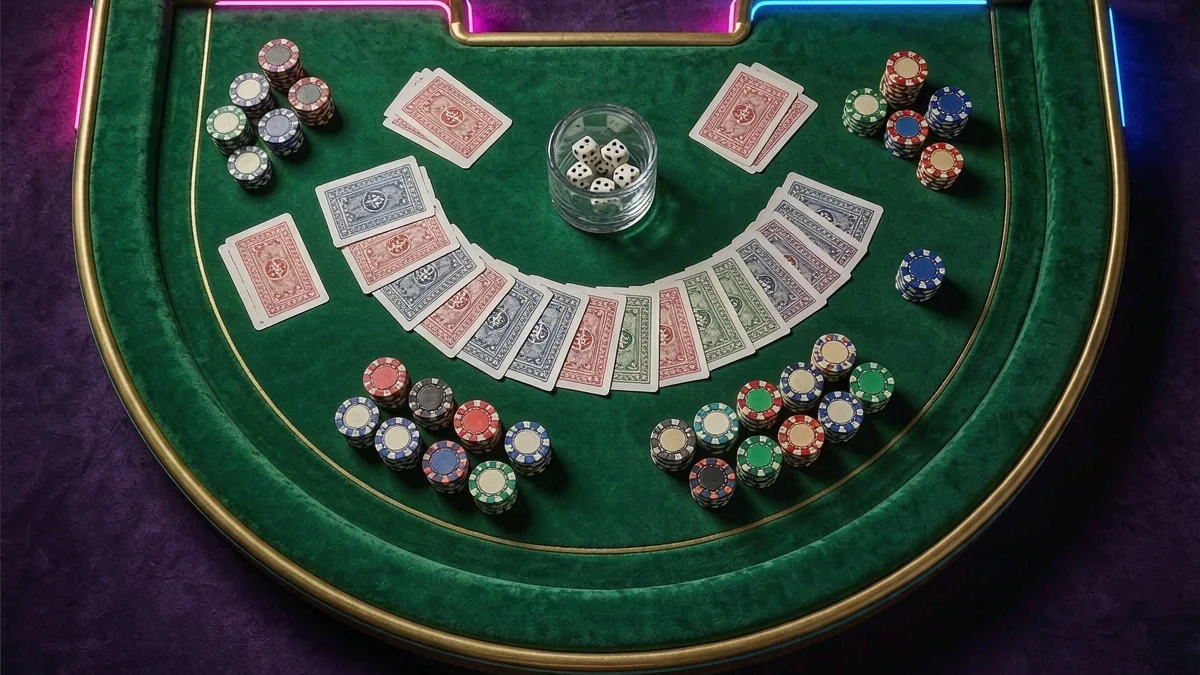
A general card-game illustration used to explain pool rummy concepts; it is not a verified 3666bet game screen.
How Pool Rummy Is Structured
On a typical turn, a player draws from the stock or an allowed discard source and then discards one card. The aim is to form sequences with consecutive cards of the same suit and sets with cards of the same rank from different suits. Joker use, any required pure sequence and the conditions for a valid declaration must be checked in the table's own rules.
In a pool format, the result of one hand is often not the final result. Penalty scores can accumulate across deals, so holding risky cards for too long may affect later standings. The elimination threshold, tie procedure and penalty for leaving mid-session differ by version.
Start by viewing the hand in three groups: completed combinations, promising combinations and isolated cards. Avoid breaking completed groups without a clear reason, compare how many cards could improve each promising group, and consider the penalty risk of isolated high-value cards. This is a method for evaluating a hand, not a guarantee of winning.
A fast declaration is not always a good declaration. Declaring without checking whether the assembled hand is valid may carry a substantial penalty under the table rules. Recheck suits, order, duplicate card use and the role of jokers before deciding.
- Compare sequence potential
- Reduce isolated high cards
- Track the discard pattern
A general illustration for sets, sequences and discards; it does not document a specific interface.
Balancing Table Observation, Patience and Decisions
The discard pile provides visible information. Cards an opponent takes or releases may suggest what they want, but their complete hand remains unknown. Do not lose the simplest route to improving your own hand while trying to infer too much about an opponent.
Do not judge a card only by whether it works immediately. Consider how many possible sequences it can join, how many alternative cards could help and how much penalty it adds if unmatched. Connected middle cards often offer more routes than a completely isolated card, but the correct decision always depends on the current hand.
Brief notes make decision patterns easier to recognise. Record which card you held too long, which possibility you overvalued and what check you missed before declaring. A simple win-loss record does not reveal the quality of the decisions.
Card distribution is uncertain. A sound plan can fail after poor draws, while a weak decision can occasionally survive through favourable cards. Judge a strategy across a series of decisions rather than by the outcome of one hand.

- Prioritise your own hand
- Observe visible discards
- Account for uncertainty
A general card-game illustration about balancing table observation and decision-making.
Practice Methods for New and Experienced Players
A new player's first task should be reading the table-specific rules. Identify valid sets, pure-sequence requirements, joker rules, declaration steps, drop penalties and the pool limit separately. Use a free practice mode first if one is available, but do not assume the table provides one.
Experienced players can examine their discard patterns. Look for habits such as repeatedly holding the same type of blocked card, feeding an opponent's visible interest or releasing high-penalty cards too late. The goal is to reduce recurring mistakes, not to claim a certain outcome.
As play speeds up, use a short decision routine: check whether completed groups remain intact, where the new card fits, which card has the fewest routes and whether a declaration is valid. A consistent routine can reduce time pressure, though it cannot remove card uncertainty.
Set one learning goal per session, such as reducing unused high cards earlier or improving declaration checks. Record time, spending and breaks as well. Greater playing skill does not remove financial risk.

- Read the rule summary first
- Set one goal per session
- Record time and spending separately
A general illustration of practice and note-taking for new and experienced players.
Budget, Breaks and Responsible-Play Limits
Third-party descriptions mention rummy among 3666bet's reported game categories, but current availability of the pool-rummy format is unconfirmed. In pool rummy generally, each player starts with a set number of points; after each deal, points are added for unmatched cards, and a player is eliminated upon reaching the stated limit. Always treat the rules shown at the table as definitive.
Before playing, check the point limit, the rules for valid sequences and sets, joker use, and the consequence of an invalid declaration. The usual first objective is to form at least one pure sequence, then arrange the remaining cards into valid combinations. When deciding what to keep or discard, consider both your own hand and which discards opponents are picking up.
Patience matters, but no decision guarantees an outcome. Rather than waiting too long for an unlikely combination, consider whether the cards can support an alternative sequence or set. Avoid discards that clearly complete an opponent's visible pattern. Increasing risk to recover lost points is not a sound strategy.
Pool rummy is primarily about arranging cards, observing discards, and managing points across multiple deals. To review your play, record the points from each deal, invalid declarations, and the types of hands that left you holding high-value cards. Such records can help analyse decisions, but they cannot predict future results or guarantee profit.
Checks Before Playing
Check the table rules, point limit and participation cost, then set a time and spending limit before starting. This is an independent information page; it does not open accounts or provide access to games.
Related Guides
Pool Rummy at a Glance
| Topic | General Guidance |
|---|---|
| Format | Multi-deal elimination card game |
| Best suited to | Players learning meld planning and point control |
| Main focus | Forming valid sequences and reducing points in hand |
| Availability on 3666bet | Not confirmed in the current game listing |
Plan Sequences First
Understand the pure-sequence requirement first, then arrange consecutive cards of the same suit into valid melds. Exact rules may vary by table.
Track the Point Limit
Pool rummy usually runs across multiple deals, with points accumulating toward an elimination limit. Check the specific limit and scoring rules before playing.
Review Your Decisions
Note which discards opponents pick up, which cards remain stuck in your hand, and when you drop; this makes later review easier. If stakes are involved, set time and spending limits in advance.
